Why Multiple Metrics Exist
There is no single, universally agreed-upon measure of a domain's authority. Search engines don't publish their internal scores, so every third-party tool has to reverse-engineer what makes a domain rank well. The result is a handful of competing metrics, each built on different data sets, different crawling frequencies, and different algorithms.
This isn't a flaw in the system — it's actually useful. Because each metric looks at the web through a slightly different lens, comparing them gives you a more complete picture than any single score ever could. But you need to know what you're comparing.
Trust Flow and Citation Flow
Trust Flow (TF) and Citation Flow (CF) are paired metrics that measure different aspects of a site's backlink profile. Citation Flow measures the raw quantity and influence of links pointing to a domain — essentially, how many links exist and how connected they are. Trust Flow takes this further by filtering for quality: it starts with a manually curated seed set of trusted websites and measures how closely your domain's backlinks connect to that trusted core.
Think of Citation Flow as volume and Trust Flow as quality. A domain could have a CF of 50 (lots of links) but a TF of only 8 (those links come from low-quality or spammy sources). That's a red flag.
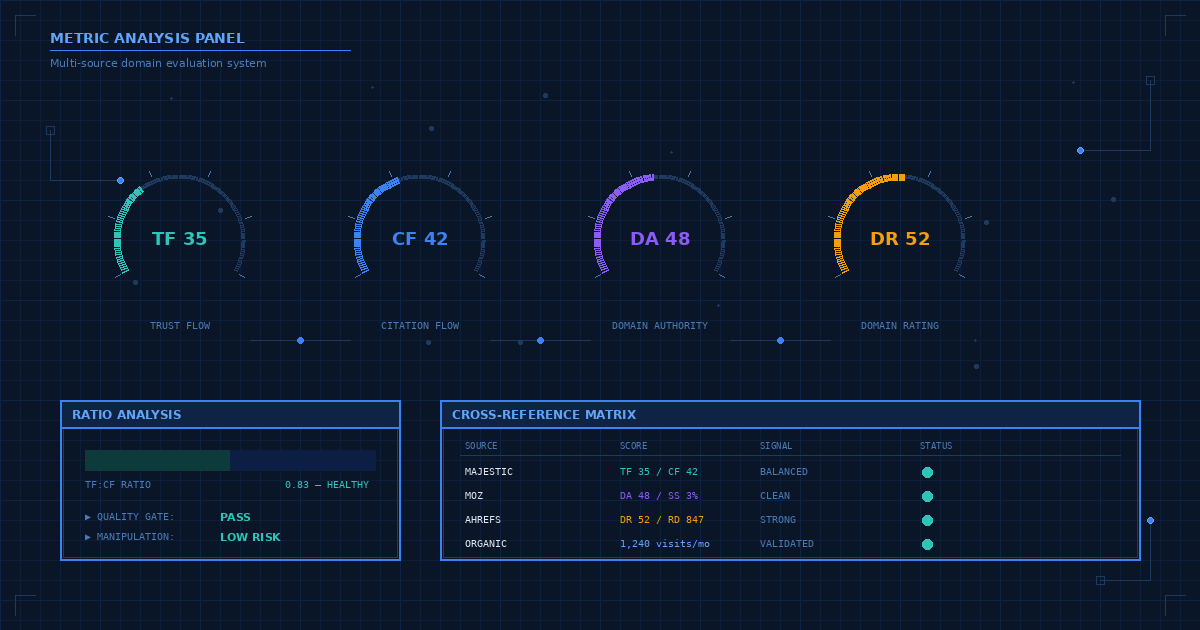
The TF:CF ratio is one of the most useful quick-read indicators in domain evaluation. A ratio above 0.5 generally indicates a healthy, natural backlink profile. Below 0.3 suggests the domain has accumulated a lot of low-quality links relative to its trusted ones — often a sign of past link schemes or spam.
Topical Trust Flow
Beyond the headline TF number, there's a topical breakdown that categorises a domain's trust into specific verticals — health, business, technology, recreation, and so on. This is particularly valuable for expired domain evaluation because it tells you what a domain is actually known for in the eyes of search engines. A photography domain whose topical trust is concentrated in "Arts/Photography" is far more valuable than one whose trust is spread across gambling and pharma categories.
Domain Authority
Domain Authority (DA) is a score from 0 to 100 that predicts how likely a domain is to rank in search results. It's built on a machine learning model trained against actual search engine results pages — the algorithm looks at which domains rank well and reverse-engineers what link characteristics they share.
DA is calculated using a domain's total linking root domains, total number of links, and a proprietary machine learning algorithm. It updates on a monthly cycle, which makes it one of the more stable metrics — you won't see wild daily fluctuations. This stability is a double-edged sword: it's reliable for trend analysis, but it can be slow to reflect recent changes like a sudden influx of new backlinks or a major link cleanup.
Spam Score
Alongside DA, there's a companion metric called Spam Score that evaluates how similar a domain's characteristics are to sites that have been penalised or banned by search engines. It checks for patterns like thin content, excessive external links, low organic traffic, and domain name characteristics commonly associated with spam networks. A low Spam Score combined with a reasonable DA is a much stronger signal than DA alone.
Domain Rating
Domain Rating (DR) specifically measures the strength of a domain's backlink profile on a logarithmic scale from 0 to 100. Unlike DA, which tries to predict search ranking broadly, DR focuses purely on link equity — how much "link juice" a domain carries based on who links to it and how strong those linking domains are.
DR updates more frequently — typically on a weekly cycle — which makes it more responsive to recent changes but also more volatile. A single high-authority link can push DR up noticeably within a week, and losing that link will drop it just as fast.
The logarithmic scale means that moving from DR 20 to 30 is relatively straightforward, but moving from 70 to 80 requires an exponentially larger number of quality backlinks. This mirrors how authority actually works in practice — the higher you go, the harder each point becomes.
Why Metrics Diverge
It's very common to see a domain with a DA of 35, a DR of 50, and a TF of 20. This doesn't mean two of the three tools are wrong — it means they're measuring different things from different data sets.
The divergence comes from three main factors:
- Different crawling scope. Each tool maintains its own web crawler, and they don't all discover the same links. One tool might see a backlink from a niche industry site that another tool's crawler hasn't reached yet.
- Different update frequencies. Monthly updates versus weekly updates versus near-real-time updates mean that at any given moment, each tool is working with data from a different point in time.
- Different algorithms. A tool that weights link diversity heavily will score a domain differently than one that weights raw link volume. Neither is wrong — they just prioritise different signals.
This is exactly why experienced domain evaluators don't rely on a single metric. The real insight comes from the pattern across all of them. If every metric rates a domain as moderate to strong, that's a much more confident signal than one outlier score.
How Metrics Can Be Manipulated
Any metric that can be measured can be gamed, and SEO metrics are no exception. Studies have shown that some metrics can be artificially inflated for as little as a few dozen dollars using networks of interlinked sites or purchased links from PBN resellers.
DR tends to be the most easily inflated because it responds quickly to new links and doesn't deeply evaluate the quality of linking sites. DA is somewhat more resistant because its monthly update cycle and machine learning model are harder to trick in the short term. TF is the hardest to inflate artificially because of its trust-based seed set — you'd need links from genuinely trusted sources, which are much harder to buy.
Watch for: DR significantly higher than DA (suggests purchased links), high CF with low TF (spammy link profile), sudden metric jumps without corresponding traffic increases, and metrics that don't match the domain's visible content quality. Any of these patterns warrant deeper investigation before you commit to an acquisition.
Which Metrics Matter Most
No single metric should drive a decision. The most reliable approach is to cross-reference:
- TF:CF ratio for backlink profile health
- Topical Trust Flow for niche relevance
- DA + Spam Score for ranking potential and risk assessment
- DR for raw link equity
- Organic traffic estimates for real-world validation
When all of these align — reasonable TF:CF ratio, strong topical relevance, clean spam score, consistent DA and DR, and verified organic traffic — you're looking at a domain with genuine authority. When they diverge significantly, that's your signal to dig deeper into the backlink profile, content history, and indexing status before making any decisions.
Understanding what each metric actually measures — and what it doesn't — is the foundation of intelligent domain evaluation. The tools are useful, but only when you know how to read them together.