Why the Lifecycle Matters
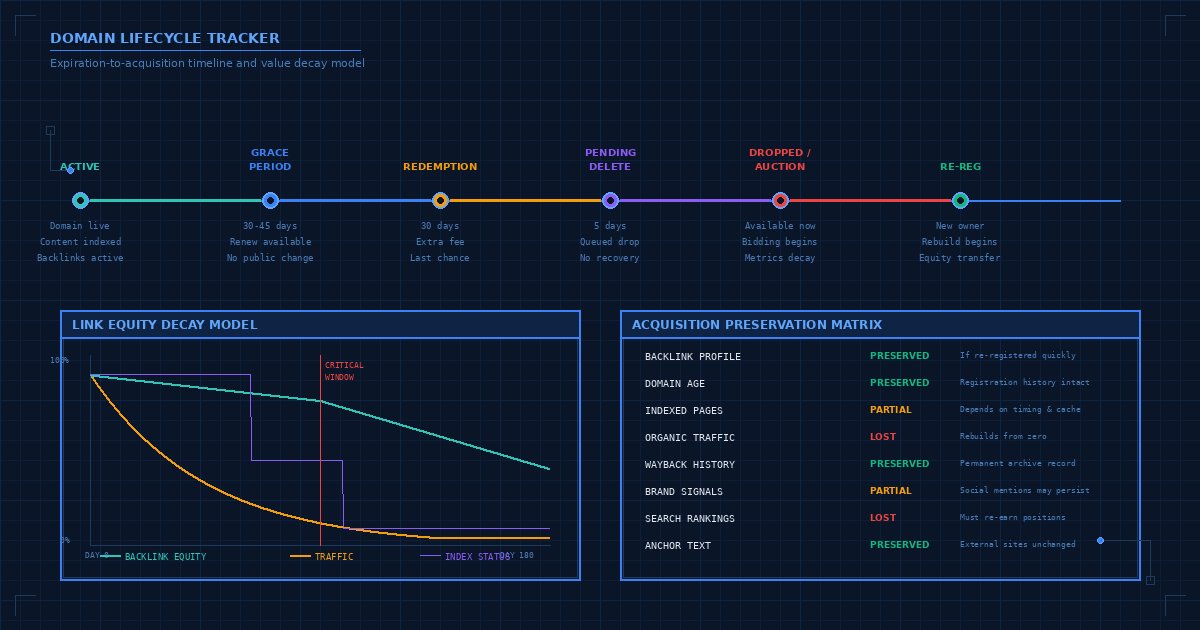
The period between a domain's registration lapse and its availability for re-registration is not a simple binary event. It's a sequence of defined stages, each governed by registrar policy and ICANN rules, with different implications for the domain's link equity, indexed pages, and acquisition cost at each step.
Buying a domain in the wrong window means paying a premium for authority that has already begun to decay. Buying in the right window — ideally at or shortly after the drop — gives you the best chance of inheriting the full weight of the domain's backlink history. Understanding the stages is the foundation of any serious expired domain acquisition strategy.
The Six Stages of Domain Expiry
The optimal acquisition window is at or shortly after the drop — before significant time has elapsed and before the domain becomes widely visible in expired domain marketplaces. Domains that appear prominently in tools like Expired Domains or ODYS have already been discovered, filtered, and priced accordingly.
Link Equity Degradation: What the Decay Actually Looks Like
The question every expired domain buyer wants answered is: how fast does authority decay, and what can I still count on when I re-register? The honest answer is that it depends on several factors — but the general pattern is consistent.
Backlink Profile
The external links pointing to a domain do not disappear when the domain expires. They remain live on the linking sites until those sites actively remove or change them. In the short term — within the first three to six months after a domain drops — the majority of the backlink profile is still intact.
However, the link equity those backlinks pass is degraded. When a linking site's crawler visits the old URL and finds no content (or a parking page), the signal value it can pass is reduced. Google's systems also factor in the absence of active content at the target URL when calculating how much authority to assign.
Over longer periods — twelve to eighteen months — you'll see more significant erosion. Webmasters who notice broken links may remove them. Sites that were themselves abandoned will eventually lose their own authority. And Google's crawl data, which informs authority calculations, gradually registers the absence of the original site.
Organic Traffic
Traffic is lost immediately and entirely. The moment a domain goes offline, every position it held in search results disappears. Unlike backlinks, which remain on external sites, search visibility is tied directly to the presence of indexable content. When the content disappears, the rankings go with it.
This is one of the most important points to understand when you're evaluating an expired domain's potential. You're not acquiring a site that's generating traffic — you're acquiring a domain whose history and backlink profile give your new content an accelerated path to traffic. That's a meaningful advantage, but it's different in kind from buying an active site.
Indexed Pages
Google progressively deindexes pages from a domain as it detects they're no longer live. During the grace period this process hasn't started. During the redemption period it begins. By the time a domain has been available for re-registration for several months, most or all of its original pages are typically deindexed.
The Wayback Machine preserves the content archive independently, which is why checking archive.org is a useful part of domain evaluation — you can understand what the site was, even after Google has removed it from its index.
What Gets Preserved vs. Lost
| Signal | Status | Notes |
|---|---|---|
| Backlink Profile | PRESERVED | External links remain on linking sites; equity degrades over time but profile persists |
| Domain Age | PRESERVED | Registration history remains intact; WHOIS will show original registration date |
| Wayback History | PRESERVED | Internet Archive maintains independent record of site content |
| Anchor Text Distribution | PRESERVED | Anchor text on linking pages is unchanged unless those pages are edited |
| Indexed Pages | PARTIAL | Google deindexes over time; fast re-registration improves retention |
| Brand Signals | PARTIAL | Social mentions and citations may persist; brand recognition fades |
| Organic Traffic | LOST | Rebuilds from zero; re-earned through new content |
| Search Rankings | LOST | All positions must be re-earned; historic authority accelerates recovery |
How This Affects Acquisition Strategy
The lifecycle model has concrete implications for how you should approach expired domain acquisition. The most common mistake is treating all expired domains as equivalent regardless of how long they've been sitting dormant.
Act on Fresh Drops First
A domain that dropped yesterday has a fundamentally different profile from one that's been parked for two years. The recently dropped domain still has most of its backlink equity intact and its Majestic/Ahrefs metrics are still an accurate reflection of its actual authority. The two-year-old domain may show the same numbers in prospecting tools, but those numbers are stale — the underlying equity has been degrading throughout the dormancy period.
When you're prospecting, filter by registration date where possible, and prioritise domains that haven't been sitting dormant for extended periods. The metrics you see in tools like Expired Domains or Majestic are snapshots — they don't update continuously, and a domain's actual current authority may be lower than its displayed TF suggests if it's been dormant for a year or more.
Re-Register Quickly After Acquisition
Once you've acquired a domain, the clock is running on every day it sits without content. Getting a basic site up — even a simple landing page with relevant content — stops the deindexation process and begins re-establishing crawlability. This doesn't need to be your full content plan; it needs to be enough to signal to Google that the domain is active again.
In practical terms, this means having a deployment process ready before you finalise acquisition, not after. If you're buying through an auction and there's a 7-day payment window, use that window to prepare your hosting and initial content rather than treating it as downtime.
Understand What You're Paying For at Auction
Premium expired domains in auction platforms like GoDaddy Auctions or ODYS Global are priced based on their visible metrics — primarily TF, DR, and referring domains. Auction buyers who don't account for the lifecycle stage are often paying premium prices for authority that's already substantially decayed.
A domain that's been sitting in a premium marketplace for six months while being listed at $2,000 may have the metrics to justify that price on the day it dropped. But six months of dormancy and continued deindexation have eroded a portion of that value. The domain you're buying is not the same domain it was when the metrics were measured.
For a full walkthrough of how to evaluate a domain once you understand its lifecycle position, see the Five-Step Domain Evaluation Framework.
If a domain has been dormant (no active site, no content) for more than 12 months, apply a meaningful discount to whatever TF/DR metrics you see in prospecting tools. The displayed numbers reflect historical authority, not current equity.
The Case for Fast Re-Registration
There's an argument to be made for acquiring domains that haven't yet hit the auction platforms — catching them at the drop, before they become visible to the broader expired domain buying community. Drop-catching services like Dropcatch and SnapNames operate at this level, watching the pending delete stage and registering domains in the seconds after they become available.
This approach requires more infrastructure and process overhead, but the reward is access to domains at standard registration prices rather than auction premiums — and at a lifecycle stage where authority is at its freshest.
For most buyers, the auction market is more practical. But understanding the lifecycle clarifies why domains at this level can justify their prices — and why domains that have been sitting unsold in secondary marketplaces for extended periods often represent less value than their headline metrics suggest.