Why Metrics Alone Aren't Enough
It's tempting to filter expired domain lists by Trust Flow or Domain Authority and buy whatever scores highest. But metrics are backward-looking summaries — they compress a domain's entire link history into a single number. They can't tell you whether the backlinks are from relevant sites, whether the domain was used for spam before it expired, or whether it's still indexed by search engines at all.
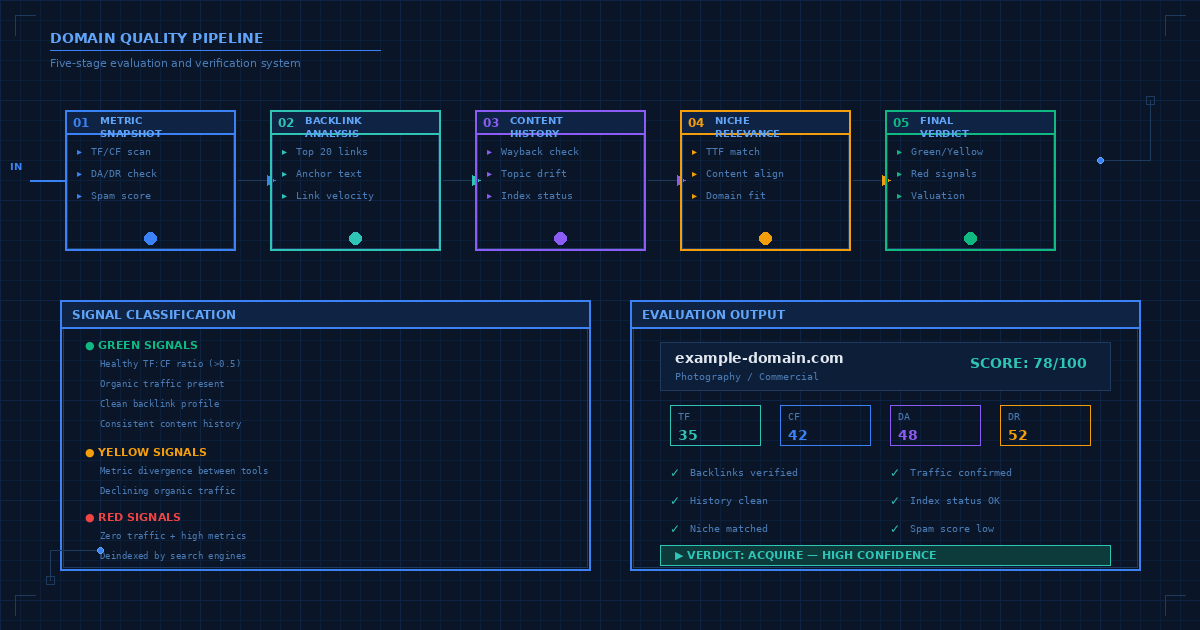
A proper evaluation needs to answer five questions: Are the metrics real? Are the backlinks valuable? Is the history clean? Does the niche match? And given all of that, what's it actually worth? That's the framework.
Step 1: The Metric Snapshot
Start with the numbers. Pull the domain's Trust Flow, Citation Flow, Domain Authority, and Domain Rating from their respective tools. Check the spam score. Look at estimated organic traffic.
At this stage, you're not making a decision — you're establishing a baseline. The numbers tell you whether it's worth investigating further. A domain with a TF of 2 and a DA of 5 probably isn't worth your time regardless of how perfect the domain name sounds. Conversely, a domain with a TF of 25, a DA of 40, and verified organic traffic of 500+ visits per month warrants a deep look.
For most use cases, the minimum threshold worth investigating is a TF:CF ratio above 0.4, a DA above 15, and a spam score below 5%. Anything below these thresholds is usually not worth the time to evaluate further, though exceptions exist for domains with exceptional niche relevance.
Cross-referencing metrics
Pay attention to how the metrics relate to each other. If DR is 55 but DA is only 20, that gap suggests the backlink profile might be artificially inflated — DR responds faster to new links and is easier to manipulate. If TF is high but CF is also high with a poor ratio, the domain likely has a bloated link profile with lots of low-quality links dragging the trust score down relative to volume.
Step 2: Backlink Analysis
This is where most of the evaluation work happens. Pull the domain's backlink profile and examine the top 20-30 referring domains by authority. You're looking for:
- Relevance. Are the linking sites in a related niche? A photography domain with backlinks from photography forums, camera review sites, and local business directories has a natural-looking profile. The same domain with links from casino sites and pharma blogs does not.
- Diversity. A healthy profile has links from many different domains, not dozens of links from just two or three. High concentration in a few sources is often a sign of paid link schemes.
- Anchor text distribution. Natural anchor text is messy — brand names, URLs, "click here," random phrases. If the top anchors are all exact-match keywords like "best photography studio" or "buy cameras online," that's a strong signal of deliberate manipulation.
- Link velocity. Check whether the domain acquired links gradually over time or in sudden bursts. Organic link building is gradual. A spike of 500 links in one month followed by silence is almost always purchased.
Red flags to watch for
Foreign-language links from completely unrelated sites (especially gambling, pharma, or adult content), links from known link farms or PBN reseller networks, and a large number of links from domains that no longer exist. Any of these should make you proceed with extreme caution.
Step 3: Content History
Every expired domain had a previous life. Understanding that life is essential to knowing what you're actually buying. Use web archives to view the domain's historical content — what was the site about? Was it a legitimate business? A blog? A spammy doorway page?
Look at the full timeline, not just the most recent snapshot. A domain might have been a legitimate photography studio for ten years, then got picked up by a spam operation for its last six months before expiring. That recent spam activity could have triggered penalties that persist even after the domain drops.
Topic drift
One of the most underrated signals is topic consistency. A domain that has been about outdoor recreation for its entire history carries genuine topical authority in that space. A domain that started as a pet care blog, became a cryptocurrency news site, then pivoted to fashion before expiring has confused its topical signals beyond recovery. Search engines track these shifts, and inconsistent topic history dilutes whatever authority the domain once had.
Index status
Check whether the domain is currently indexed by searching for site:domain.com in Google. If it returns zero results despite having strong metrics, that's a major red flag — it may have been manually penalised or deindexed. Rebuilding from a deindexed domain is possible but significantly harder and slower than building on one that's still in the index.
Step 4: Niche Relevance
Even if a domain passes every other check, it needs to match the niche you're building in. A domain with strong metrics in the fitness vertical isn't useful if you're building a portfolio of technology sites. The topical authority doesn't transfer across unrelated verticals.
Check the domain's Topical Trust Flow breakdown to see where its authority is concentrated. The top categories should align with your intended use. A domain whose trust is spread across "Health," "Recreation/Fitness," and "Shopping/Sports" is a natural fit for a fitness or outdoor recreation site. One whose trust sits in "Computers/Programming" is not, regardless of how good the headline metrics look.
The domain name itself matters too. A domain called "greenridgelandscaping.com" will always perform better in the outdoor/gardening niche than in finance. The name sets expectations for both users and search engines about what content belongs there.
Regional relevance
For expired business domains specifically, the domain often carries geographic signals — backlinks from local directories, regional news sites, and nearby businesses. If the original business was in Denver, the backlink profile will lean toward Colorado-based sites. This regional authority is valuable if you're building content relevant to that area, but it's wasted if you're targeting a completely different geography.
Step 5: The Final Verdict
By this point, you have a complete picture: metrics, backlink quality, content history, and niche alignment. The final step is synthesising all of it into a decision.
Green light: Healthy TF:CF ratio, clean backlink profile with relevant links, consistent content history in your target niche, currently indexed, verified organic traffic. These domains are worth their asking price and then some.
Yellow light: Strong metrics but some concerns — moderate topic drift, a few questionable backlinks, metrics that diverge between tools. These can still be good acquisitions if the price is right, but build in extra aging time before linking to money sites.
Red light: Deindexed, heavy spam history, manipulated metrics, no organic traffic despite high scores, or niche mismatch. Walk away — no amount of content can fix a poisoned foundation.
What This Looks Like in Practice
Imagine you find an expired domain called "summitpeakphotography.com." The metric snapshot shows TF 18, CF 24, DA 32, DR 28, Spam Score 2%. The TF:CF ratio is 0.75 — healthy. All metrics are in a similar range — no suspicious outliers.
You pull the backlinks. The top referring domains include a local chamber of commerce, two photography forums, a wedding planning directory, and a regional newspaper. The anchor text is mostly the business name and URL. Link velocity was steady over four years with no sudden spikes. Clean.
The web archive shows a consistent photography studio website for five years — portfolio pages, a blog with photography tips, a booking page. No topic drift. The domain is still in Google's index with a handful of cached pages.
Topical Trust Flow is concentrated in "Arts/Photography" and "Society/People." The original business was in Portland, Oregon, with backlinks from Portland-area directories and publications.
Verdict: strong acquisition for a photography niche site, especially if you plan to target Pacific Northwest content. Every signal aligns. That's what a green light looks like.
The framework isn't complicated, but it is thorough. Skipping any of these steps — especially the backlink analysis and content history — is how people end up overpaying for domains that look good on the surface but carry hidden liabilities. Take the time to run every check, and the quality of your portfolio will reflect it.