The Niche Alignment Problem
When most expired domain buyers evaluate a prospect, they follow a metric-first process: filter by Trust Flow threshold, check the TF:CF ratio, verify no manual penalties. If the numbers pass, the domain gets shortlisted. The content history — what the site was actually about — often gets skipped entirely or treated as a secondary concern.
This is a mistake, and it's one that produces consistently disappointing results. Authority in Google's systems is not domain-wide in the way a single TF score implies. It's topically distributed. A domain that built authority in the home improvement space over eight years carries genuine, compounding trust in that topic area. Move that domain to a technology content strategy and you're starting largely from scratch, despite the inherited metrics.
Google's understanding of topic authority has become increasingly granular. The search engine doesn't just evaluate whether a domain is "authoritative" — it evaluates whether a domain is authoritative for a specific subject matter. A domain's historic subject footprint is part of how that domain is positioned in Google's model of the web.
Topical Trust Flow (TTF) in Majestic shows you the subject areas where an incoming domain has earned authority. Strong TTF alignment with your intended content niche means the domain's historic authority works in your favour. Misalignment means you're carrying deadweight metrics that won't transfer.
How Topical Consistency Compounds Authority
The compounding effect of topical consistency is one of the most underappreciated mechanisms in SEO, and it's particularly relevant to domain selection. When a site publishes coherent content about a specific subject area over an extended period, several things happen simultaneously that reinforce each other.
Backlinks from relevant sites accumulate. Sites that cover home improvement link to other sites that cover home improvement — the incoming links are topically coherent, which makes the trust signal they pass more valuable. Over time, a domain with consistent niche focus attracts better links from better sources because the site is recognised as a resource within that specific community.
Google's crawl patterns also adapt to a consistent domain. A site that reliably publishes relevant content gets crawled more frequently, indexed more promptly, and surfaced more readily for queries in that subject space. When you acquire a domain with that kind of consistent historic footprint and continue building within the same topic area, you're building on top of an established foundation rather than trying to redirect authority that doesn't belong to your subject matter.
The alternative — acquiring a high-TF domain from a completely different niche and publishing unrelated content — creates what practitioners often call topical drift. The domain's backlink profile references one subject area; its new content is about a different one. This inconsistency is something Google's systems are equipped to detect and discount.
Alignment vs. Misalignment: What It Looks Like in Practice
Home improvement domain → DIY renovation content
TTF categories: Home/Renovating, Construction. New content covers bathroom remodels, kitchen updates, tile work. Historic backlinks come from hardware retailers, contractor directories, and lifestyle publications. Everything reinforces the same topical space.
Home improvement domain → Finance content
TTF categories: Home/Renovating, Construction. New content covers personal finance, investment, budgeting. Incoming backlinks are from irrelevant domains. Google sees a content pivot that makes no topical sense relative to the domain's established authority signals.
Plumbing domain → Home improvement content
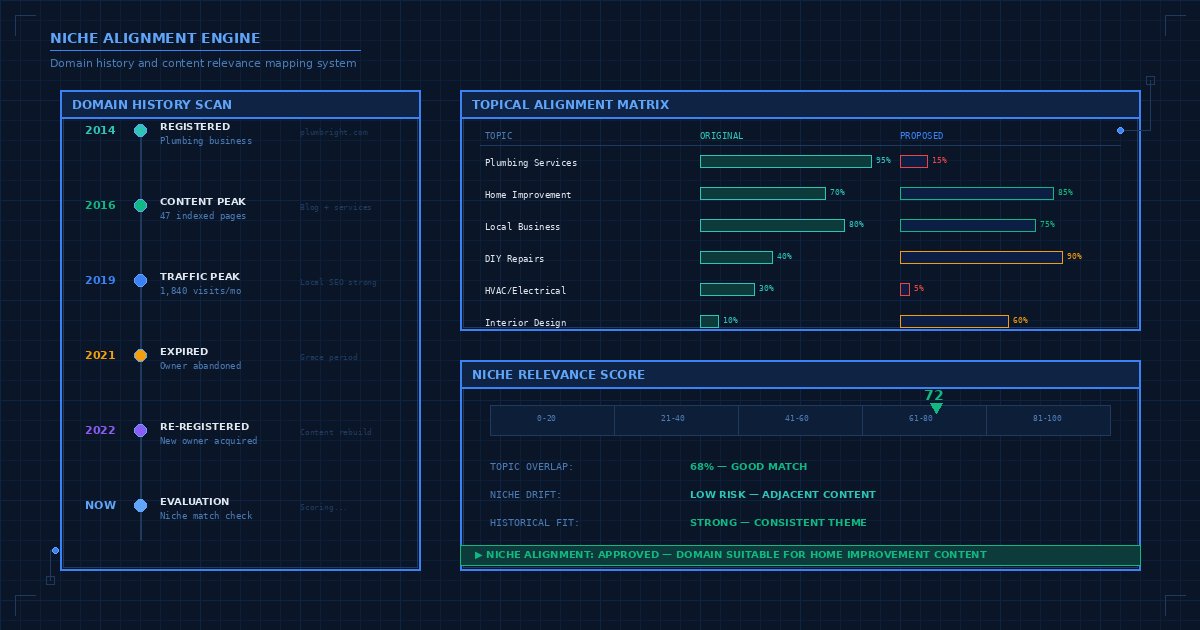
TTF categories: Home/Maintenance, Plumbing. New content covers broader home improvement topics. The subject overlap is strong — plumbing sits within the home improvement category hierarchy. The historic backlink profile will transfer authority into adjacent content reasonably well.
Legal services domain → Health content
TF 28, DR 31 — impressive numbers. TTF categories: Law/Legal Services. New content covers medical topics. The metrics look strong, but the topical authority is entirely in the wrong subject space. The numbers create false confidence.
Using Wayback Machine for Content Strategy
The Internet Archive's Wayback Machine is an underused tool in domain evaluation, and it's particularly valuable for understanding niche alignment. Before any acquisition, you should look at what the domain actually published — not what Majestic's TTF categories suggest, but what real pages existed at the site's peak.
What to Look For
Access archive.org and enter your target domain. Look at snapshots from the site's most active period — typically identifiable as the time when it was accumulating the most content and traffic. Browse category pages, individual articles, and any about or editorial pages to understand the site's actual subject focus.
A few things to assess: Was the content genuinely editorial and written for readers, or was it thin, templated, or clearly generated for search engines? Is the subject matter consistent across the site's history, or did it pivot multiple times? Does the content quality level suggest the kind of site that earned links naturally, or one that was built primarily for link placement?
A domain with consistent, quality editorial content in a niche across multiple years is a fundamentally different acquisition from one with scattered, low-quality content despite comparable metrics. The Wayback Machine makes this visible in ways that TF and DR cannot.
Identifying Topical Drift in the Domain's Own History
Sometimes the misalignment problem isn't between the domain and your content plan — it's within the domain's own history. A site that started as a home improvement resource in 2010 but became a general lifestyle blog by 2018 has a split topical footprint. The authority it accumulated in home improvement is real, but it's been diluted by years of off-topic content.
In these cases, the TTF categories may still show home improvement as the primary category — because the early content still contributes to the backlink profile — but the more recent history may have muddied the signal. This is worth factoring into your evaluation and your expectations for how the domain will perform.
Matching Content to Domain Footprint
Once you've identified a domain with strong niche alignment, the content strategy for the rebuilt site should deliberately connect to what the domain's history established. This doesn't mean copying the previous site — it means building within the same topical space in a way that allows the domain's historic authority to contribute meaningfully to your new content's performance.
Practically, this means selecting your primary content categories based on the domain's strongest TTF signals, not based on a generic content plan you've applied to all your domains. If a domain's primary TTF category is Computers/Software, building software review content leverages the historic authority. Building photography tutorials on the same domain produces slower, less certain results.
Category Depth Over Breadth
There's also value in building deep within the niche rather than trying to cover the entire topic space. A domain that was historically strong in the "Home/Outdoor" Majestic category benefits most from content that goes deep on outdoor living, landscaping, and garden design rather than spreading into generic home improvement content that overlaps with hundreds of competing domains.
This approach mirrors how Google's topical authority model works: depth within a subject signals genuine expertise, while breadth without depth signals a content farm. The domains you're acquiring should have existing signals of depth — and your content strategy should reinforce rather than dilute those signals.
When building out content on an acquired domain, look at the Wayback Machine snapshots and note the specific topics and article angles the site covered at its peak. These are the content areas where the domain has the strongest historical footprint — and the areas where new content will benefit most from the domain's inherited authority.
The Compounding Effect Over Time
The real payoff of niche alignment isn't visible in the first few months — it emerges over time as the combination of strong historic signals and coherent new content begins to compound. A domain with genuine topical authority in a specific niche, built upon with quality content that deepens that niche focus, tends to accumulate authority faster than comparable domains built on misaligned or diluted foundations.
This compounding dynamic is one of the core reasons the expired domain acquisition model works at all. You're not just buying metrics — you're buying a head start in a specific topical space. Whether that head start translates into lasting competitive advantage depends almost entirely on how well your content strategy aligns with what the domain represents in Google's understanding of the web.
Domains that are acquired purely for their numbers and then repurposed for unrelated content often show strong early performance — Google's trust signals aren't recalibrated instantly — followed by a gradual erosion as the topical mismatch becomes more apparent in the crawl data. Domains built with alignment from day one tend to perform more slowly in the first few months but compound more strongly over a twelve to twenty-four month horizon.
For the practical evaluation steps that pull all of these factors together — metrics, lifecycle, backlink quality, and niche alignment — see the Five-Step Domain Evaluation Framework.