What Topical Authority Actually Means
Topical authority is a site's perceived expertise on a specific subject in the eyes of search engines. Unlike domain authority (which is a third-party metric based on backlinks), topical authority is earned through comprehensive, well-structured content coverage of a defined subject area.
Think of it this way: a site with one article about landscape photography and fifty articles about unrelated topics has weak topical authority in photography. A site with thirty well-interlinked articles covering every aspect of landscape photography — from equipment and technique to editing workflows and location guides — has strong topical authority in that space, even if its traditional link metrics are lower.
Search engines assess this by evaluating how thoroughly a site covers its subject matter, how well the content is interconnected, and whether the site demonstrates genuine expertise rather than surface-level keyword targeting.
The Content Cluster Model
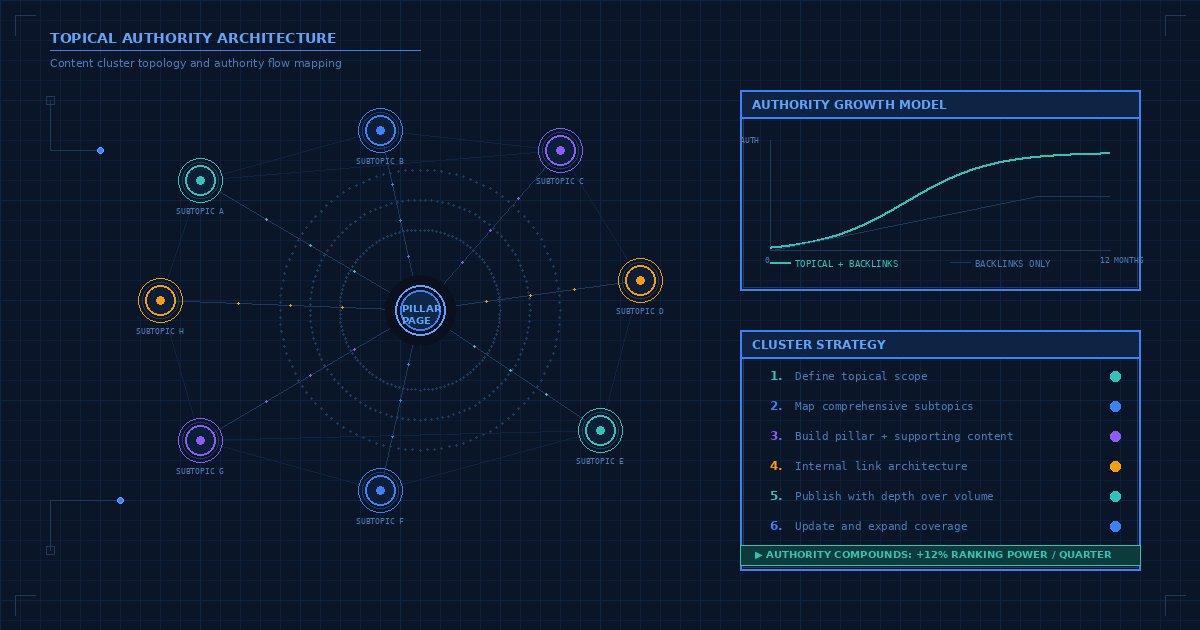
The most effective way to build topical authority is through content clusters — a structural approach that organises your content around a central topic with supporting articles that cover every meaningful subtopic.
Pillar content
At the centre of each cluster sits a pillar page — a comprehensive, long-form piece that covers the core topic broadly. For a photography site, this might be "The Complete Guide to Landscape Photography." The pillar page doesn't go deep on any single subtopic; instead, it provides a thorough overview and links out to supporting articles that do.
Pillar content serves two functions: it provides a single authoritative page that can rank for the cluster's head term, and it acts as a navigational hub that connects all the related content together. The internal links from the pillar to each supporting page pass authority and signal to search engines that these pieces are all part of a cohesive body of knowledge.
Supporting content
Supporting articles are where the depth lives. Each one tackles a specific subtopic in detail — "Best Camera Settings for Golden Hour Landscapes," "How to Use Foreground Elements in Composition," "Editing Mountain Photography in Lightroom." These articles link back to the pillar page and to each other where relevant, creating a web of interrelated content.
The key is that each supporting article should be able to stand alone as a useful, complete piece of content. They're not thin pages created just to hit keyword targets — they're genuine explorations of their subtopics that happen to be connected to a larger structure.
A well-built content cluster typically has 8-15 supporting articles around a single pillar page. Fewer than that and you haven't achieved comprehensive coverage. More than 15 and you're probably either going too granular or your topic is broad enough to split into multiple clusters.
Why This Outperforms Traditional Approaches
The traditional SEO approach was to write an article, build links to it, and hope it ranks. Content clusters outperform this for three interconnected reasons.
Coverage signals expertise. When a site has thirty articles about landscape photography — covering equipment, technique, locations, editing, printing, and business aspects — search engines recognise that this site has a comprehensive understanding of the topic. A site with one article, even with strong backlinks, can't demonstrate the same depth.
Internal links compound authority. Every link from a supporting article to the pillar page passes authority. Every cross-link between supporting articles strengthens the connections. As the cluster grows, the internal link network becomes increasingly powerful — each new article amplifies the entire structure, not just itself.
User engagement improves. Well-structured clusters naturally encourage deeper reading. Someone who lands on an article about camera settings for golden hour will likely click through to the composition article, then to the editing guide. This increased time on site and page depth signals to search engines that the content is genuinely valuable.
The compounding effect is the most important aspect. A new article in a mature cluster starts ranking faster than a standalone article ever could, because it immediately inherits context and authority from the existing cluster. The bigger the cluster, the easier it becomes to add to it.
Building a Cluster From Scratch
If you're starting with an expired domain that has some existing authority but no content, here's how to build your first cluster effectively.
1. Define your topical scope
Start with the domain's existing topical authority. Check its Topical Trust Flow to see what subjects it's already associated with. Your content cluster should align with — and extend — this existing authority rather than fighting against it. A domain with trust in "Arts/Photography" should build photography clusters, not finance content.
2. Map the subtopics
Before writing a single word, map out every meaningful subtopic within your chosen area. Research what people actually search for — not just head terms, but the specific questions, comparisons, and how-to queries that indicate real interest. A photography cluster might include technique, equipment, editing software, business (pricing, client management), specific photography types (portrait, landscape, event), and location-specific content.
3. Create the pillar first
Write your comprehensive pillar page before any supporting content. This forces you to think through the entire topic structure and identify natural breakout points for supporting articles. The pillar should be substantial — typically 2,500-4,000 words — and should link to placeholder URLs for each planned supporting article. You'll publish those articles and fill in the links over time.
4. Publish supporting content on a natural schedule
Don't publish all your supporting articles in one day. Search engines expect content to grow organically over time. A randomised publishing schedule — with articles appearing every 3-9 days — looks natural and avoids the kind of sudden content dumps that can trigger scrutiny.
Prioritise supporting articles that cover the most fundamental subtopics first. For a photography cluster, "Understanding Exposure" and "Composition Basics" should come before "Advanced HDR Blending Techniques." Build the foundation before the specialty content.
5. Interlink deliberately
Every supporting article should link to the pillar page at least once, using natural anchor text — not keyword-stuffed phrases. Supporting articles should also link to other supporting articles when the connection is genuinely relevant. If your article about camera settings mentions composition, link to your composition article. If your editing guide references specific shooting techniques, link back to those technique articles.
The goal is a web of connections that mirrors how the topics actually relate to each other, not a rigid spoke-and-hub where every page only links to the pillar.
6. Expand and update
Topical authority isn't a one-time achievement — it's maintained and strengthened by ongoing content. Add new supporting articles as the field evolves, update existing articles with current information, and deepen coverage of subtopics that are performing well in search. Each addition makes the entire cluster stronger.
Topical Authority and Expired Domains
This is where expired domains and content strategy intersect. An expired domain with existing topical authority in your target niche gives you a head start — you're not building authority from zero, you're extending authority that already exists.
The Topical Trust Flow breakdown of an expired domain is essentially a map of what search engines already believe that domain is about. When you build a content cluster that aligns with those existing signals, you're reinforcing and expanding an established position rather than trying to establish a new one. The content has a natural home.
Sites that combine a quality expired domain (existing link authority + topical signals) with a well-structured content cluster (ongoing topical authority building) consistently outperform sites that rely on only one approach. The domain provides the foundation; the content cluster builds the structure on top of it. Over time, this combination compounds — each quarter of content production adds measurably more ranking power than the last.
Measuring Topical Authority
Unlike Domain Authority or Trust Flow, there's no single number that represents topical authority. Instead, you measure it through a combination of signals:
- Keyword visibility. Track how many keywords you rank for within your topic cluster. As topical authority grows, you should see more long-tail keywords appearing without specifically targeting them — the site starts ranking for related queries naturally.
- Average ranking position. Track your average position for cluster keywords over time. A steady improvement across many keywords (rather than spikes on individual pages) indicates growing topical authority.
- Indexing speed. As topical authority strengthens, new content in your cluster gets indexed and starts ranking faster. If your early articles took weeks to rank and your latest ones are appearing within days, that's a strong signal.
- Impression share. Monitor your total impressions for topic-related queries in Search Console. Rising impressions across the cluster's keyword universe — even for pages you haven't specifically optimised — confirms that search engines see your site as a topical authority.
The key insight is that topical authority is an emergent property. You can't buy it with a single link or manufacture it with a single article. It emerges from consistent, comprehensive, well-structured coverage of a subject over time. And once established, it's remarkably durable — far more so than authority built purely on backlinks, which can evaporate when links disappear.
Depth beats volume. A site that truly owns its topic will outrank a site with more links and more pages that only skims the surface. Every article you add to a well-planned cluster makes the next one more effective. That's the compounding advantage of topical authority — and it's the foundation of every portfolio site that performs over the long term.