The Metric Trap
When expired domain buyers first learn about Trust Flow and Citation Flow, the natural instinct is to treat them like report card scores. Higher is better. More is better. A domain with 400 referring domains must be stronger than one with 40.
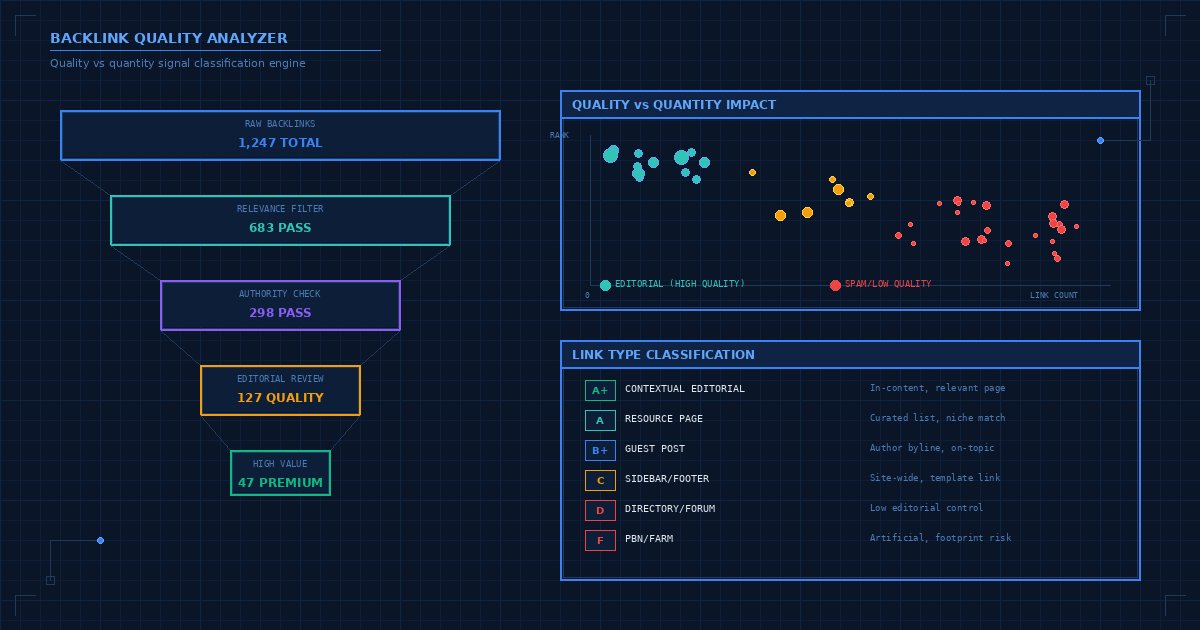
This logic is understandable but wrong, and it leads to expensive mistakes. A domain that accumulated 400 links through forum spam, web 2.0 properties, and article directories in 2014 carries less real authority than one that earned 40 contextual editorial mentions from industry publications. The raw count tells you almost nothing about signal quality.
Majestic's Trust Flow attempts to address this by weighting the quality of sources rather than counting all links equally. But TF is still just a proxy — it reflects the authority of the sites pointing to a domain, not the nature of the placement or the relevance of the context. To really understand a backlink profile, you have to look at the links themselves.
A single contextual editorial link from a relevant, trusted publication can outweigh hundreds of directory listings, footer links, or paid placements when it comes to genuine authority transfer.
What Makes a Backlink Valuable
There are four variables that determine how much value a backlink actually transfers. Every link you evaluate should be assessed against all four — weakness in any one of them reduces the signal substantially.
Source Authority
The linking domain needs genuine authority itself, not borrowed or manufactured metrics. Look for domains with established history, real editorial content, and organic traffic of their own. A link from a site that exists solely to link outward — even if it has a TF of 25 — contributes far less than a link from an active publication that happens to mention your target domain in a relevant article.
Cross-reference Majestic TF against Ahrefs DR and Moz DA. These tools use different methodologies, so a domain that scores well on all three is more trustworthy than one that only looks strong through a single lens. Significant divergence between tools — for example, TF 30 but DR 8 — is a flag worth investigating.
Topical Relevance
Google's algorithms have grown increasingly sophisticated at evaluating whether a backlink makes sense in context. A link from a home improvement blog to a plumbing supply site is topically coherent — both exist within the same subject space. That same link pointing to a financial services site is an anomaly that offers minimal benefit and may even be flagged as manipulative.
Majestic's Topical Trust Flow (TTF) categories give you a starting point here. If a domain's primary TTF categories align with the niche you're building in, the historic link profile is working in your favour. Misalignment means the equity attached to those links may not transfer to your content in the way you need.
Placement Type
Where a link sits within a page tells you a great deal about its editorial intent. In-content contextual links — placed within the body of an article, surrounded by relevant text — signal that a real editor made a deliberate decision to reference the linked resource. These are the highest-quality placements.
Sidebar links, footer links, and site-wide links are treated very differently. A site-wide footer link creates hundreds of technically separate backlinks from a single domain — but Google collapses these into a single signal and weights them accordingly. Worse, a sudden drop in these links (when a site redesigns and removes the footer) can cause a sharp, visible decline in a domain's metrics.
Anchor Text Distribution
Healthy backlink profiles have diverse anchor text — a mix of branded mentions, partial matches, naked URLs, and generic phrases like "click here" or "read more." When anchor text skews heavily toward exact-match keywords, it's a strong indicator of a manipulative link-building campaign.
For expired domains, over-optimised anchor text in the historic profile is a genuine risk factor. It means the previous owner was likely running a link scheme, and while those specific links may have been devalued, the pattern can persist in Google's assessment of the domain. If you see that 60% of anchors use the same keyword phrase, that's a profile to approach with caution.
Classifying the Link Types You'll Encounter
When auditing a domain's backlink profile — whether you're buying it or trying to understand it — these are the placement types you'll encounter, roughly ordered by quality:
| Grade | Link Type | Characteristics | Value |
|---|---|---|---|
| A+ Contextual Editorial | In-body, relevant page | Editor chose to link; topically coherent; surrounded by relevant text | Highest signal quality |
| A Resource Page | Curated list, niche match | Deliberate inclusion on a topical resource list | Strong, especially with niche alignment |
| B+ Guest Post | Author byline, on-topic | Placed within authored content; quality varies widely by site | Good if site is genuinely editorial |
| C Sidebar / Footer | Site-wide template link | Often hundreds of URLs from one domain; Google collapses these | Low; volatile if site redesigns |
| C Directory / Forum | Low editorial control | Minimal editorial gatekeeping; easy to acquire at scale | Minimal unless high-authority directory |
| F PBN / Link Farm | Artificial footprint risk | Created specifically to pass links; Google actively devalues or penalises | Risk factor, not an asset |
Link Neighbourhoods
A concept that rarely gets discussed in beginner SEO content but that matters enormously in domain evaluation is the idea of link neighbourhoods. The sites that link to your target domain, and the sites those sites link to, form a network. If your target domain's link profile overlaps significantly with known spam networks, link farms, or penalised sites, that proximity is reflected in its trust signals even if the individual links look fine in isolation.
This is one reason why Majestic's Trust Flow can be deceptive. A domain might have TF 20 based on a handful of genuinely high-quality sources, but if the rest of its link profile is sitting inside a neighbourhood of low-quality sites, the domain's overall footprint is weaker than TF alone suggests.
When evaluating a domain with above-average metrics relative to its Citation Flow (a TF:CF ratio above 0.5 is generally positive), take a closer look at where those high-TF links are actually coming from. If two or three blog network sites are generating most of the trust signal, the domain's authority is fragile.
In Majestic, filter to show only the backlinks that are contributing most to TF — then check each of those source domains independently. If more than three are obviously part of the same network, you're looking at a manufactured profile rather than earned authority.
How to Cross-Reference for a Reliable Picture
No single tool gives you a complete picture of a domain's backlink quality. The reliable method is triangulation: use multiple tools and look for consistency. When the signals agree, you can have confidence. When they diverge sharply, you have a reason to dig deeper.
The Cross-Reference Workflow
Start with Majestic. Check TF, CF, and TTF categories. If TF is above 15 and CF is not more than double the TF, the ratio is acceptable. Check which TTF categories dominate — do they align with the niche you're targeting?
Pull the same domain into Ahrefs. Look at DR and the total number of referring domains. Compare the referring domain count to Majestic's numbers — large discrepancies may indicate one tool is picking up links the other has discounted or deindexed. Also check for any traffic — domains with no organic traffic at all may have issues that metrics don't surface.
Finally, check Moz if available, and review the actual Wayback Machine content for the domain during its peak traffic period. Sites that were genuinely authoritative tend to have real content archives; link farms and PBNs often have sparse or templated content history.
Red Flags That Override Good Metrics
Certain patterns should stop an acquisition regardless of how the headline numbers look. These include: a sudden spike in referring domains within a short window (manufactured link campaign), anchor text that's more than 40% exact-match for a commercial keyword, a high percentage of links from the same IP block or hosting provider, and any history of manual actions visible in Google Search Console if you can access it.
One red flag that many buyers miss is the referral traffic pattern. A domain with TF 25 and 200 referring domains but zero historic organic traffic is almost certainly a domain built for links rather than for readers. Its authority metrics reflect manipulated signals that are likely to decay faster than a domain with comparable metrics and a real traffic history.
Applying This to Expired Domain Evaluation
When you're evaluating expired domains for acquisition, backlink quality is arguably more important than any single metric. A domain with TF 12 and 30 genuinely contextual links from relevant publications is a better foundation than a domain with TF 28 built on 800 directory submissions and sidebar links from a defunct blog network.
The practical process is: filter your prospecting pool by TF threshold, then eliminate domains with poor TF:CF ratios. For the remaining candidates, sample the actual backlinks — check ten to twenty of the top contributing sources manually. What kind of sites are they? What category? Are they real publications or obvious manufactured properties?
This manual sampling step is time-consuming but irreplaceable. It's where you find the 20% of domains that look mediocre by the numbers but have genuinely strong link profiles, and filter out the 30% that look strong by the numbers but have manufactured or volatile authority.
For a full walkthrough of the evaluation pipeline — from initial filtering through to acquisition decision — see the Five-Step Domain Evaluation Framework.